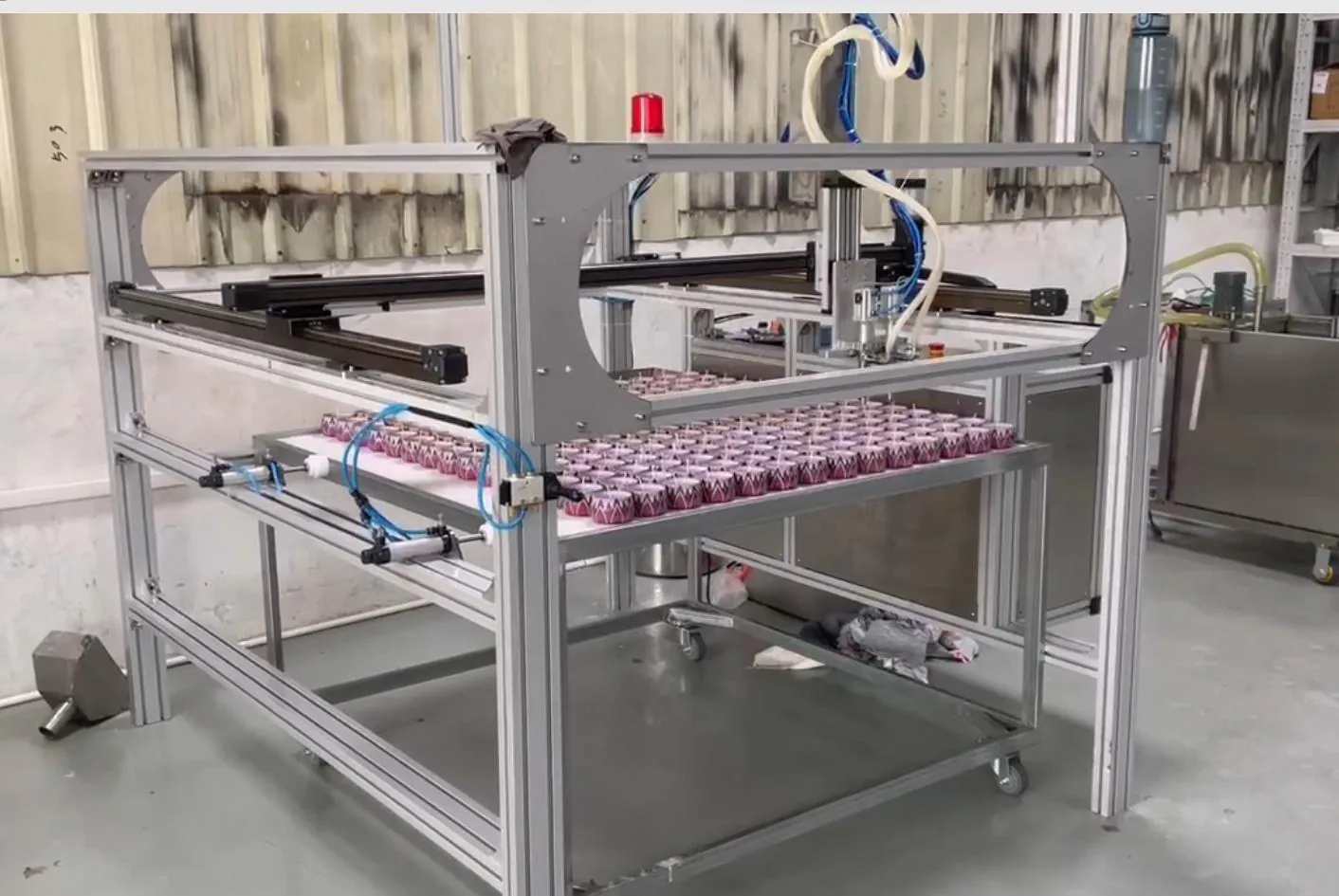
Choosing a candle filling machine comes down to four checks before speed: your jar dimensions and wick clearance, your wax pour temperature and upstream melter, your site power and floor length, and how often you change container sizes or scents. For mixed jar sizes between 40 and 100 mm in diameter and frequent changeovers, an XY-gantry tray filler is usually the first practical step up from hand-pouring. For long runs of a single container size on three-phase power, a 13- or 19-nozzle row-fill machine handles more jars per pass. Conveyor-fed lines only make sense when high, steady volume lets you remove a full manual loading or unloading position.
Start With Four Hard-Gate Checks Before Comparing Models
Most buyer mistakes happen when a team compares rated jars per minute before checking whether a machine physically fits their containers and workshop. Screen every candidate against these four gates first.
1. Container Diameter, Height, and Wick Clearance
Measure your smallest and largest jars, tins, or cups across the outer diameter, inner neck opening, and total height. On AromaEquip’s standard XY-gantry candle filling machines, the published container range is 40–100 mm in diameter and 20–100 mm in height. Containers outside that range require a drawing review and custom confirmation before quoting.
Just as critical is wick clearance. The filling nozzle must enter beside the wick without knocking the wick or its holder off-center, and without splashing wax onto the jar rim. Narrow-neck vessels, tall jars, and multi-wick bowls tighten the available space around the nozzle.
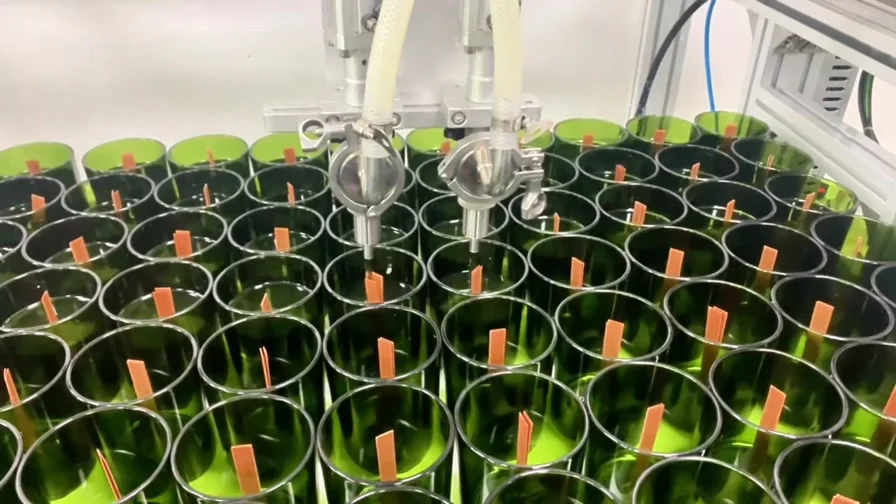
2. Wax Pour Temperature and Upstream Wax Supply
Candle fillers dispense molten wax—they do not replace bulk wax melting. Standard XY-gantry fillers heat up to 100 °C to keep wax flowing through the dispensing path, while your actual pour temperature depends on whether you run soy, paraffin, palm, coconut, or a blended wax with fragrance oil and dye.
Separate two different equipment roles early in your budget and floor plan:
- Bulk melting: Handled upstream by wax melting machines (such as 150 kg or 250 kg oil-jacketed pots) or larger candle wax melting tanks (around 600 kg per batch).
- Holding and dosing: The XY-gantry filler is sold without a melter and draws from your melter or heated tank. The row-fill machine includes a heated holding pot with a 4 m double track, but bulk melting still sits upstream.
3. Site Utilities, Machine Weight, and Floor Length
Verify electrical supply, compressed air, and physical access before you ask for a quotation. Utilities alone can disqualify a machine type if your facility cannot support it without rewiring or layout changes:
| Hard-Gate Requirement | XY-Gantry Filler (Standard) | Row-Fill Machine (Standard) | What to Confirm on Your Site |
|---|---|---|---|
| Electrical supply | 220 V AC, 50–60 Hz, 2,000 W | 380 V three-phase four-wire, 50 Hz, approx. 10 kW | Local voltage, phase, and frequency |
| Compressed air | 0.5 MPa required | Confirm in quotation | Clean, dry air line capacity at the station |
| Machine footprint & table | Overall size confirmed in the quotation; leave space for spare trays | Filler 2,800 × 1,000 × 1,800 mm; table 1,200 mm wide, up to 12 m long | Doorways, aisle clearance, and cooling length |
| Machine weight | Approx. 200 kg | Confirm in quotation | Forklift or pallet-jack access |
| Upstream wax supply | Separate wax melter or tank required | Heated holding pot included; melter still separate | Hose routing and melter placement |
4. Container Stability and Cooling Workflow
Filling only takes seconds per jar; cooling takes much longer. Before choosing a filler, map where freshly poured jars will sit while the wax sets. If you move trays by hand while the wax is still liquid, jolts can tilt wicks or splash wax up the glass wall.
XY-Gantry vs. Row-Fill vs. Conveyor Lines: Choosing Between Qualified Setups
Once your containers, wax blend, and utilities pass the hard gates, the choice between an XY-gantry filler, a row-fill machine, and a conveyor-fed line comes down to SKU variety, changeover frequency, cooling layout, and staffing.
How Each Filling Architecture Works
- XY-gantry tray filler: Jars sit stationary on a movable tray while overhead filling heads travel on X and Y axes to dose each container. An operator loads trays, slides them in, starts the fill cycle, and swaps trays out for cooling.
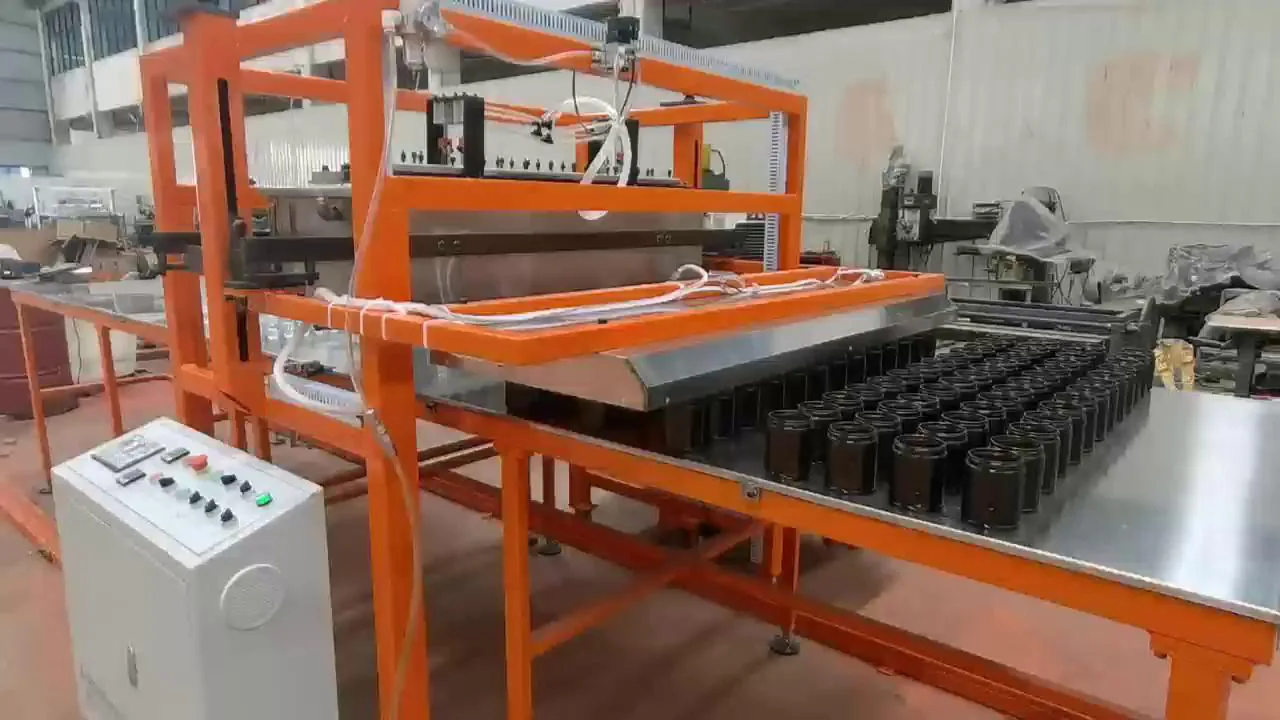
- Multi-nozzle row-fill machine: A fixed bar with 13 or 19 nozzles fills an entire row of aligned containers at once from a heated holding pot, feeding jars along a 1,200 mm wide table up to 12 m long so filling and cooling happen on the same bench.
- Conveyor-fed automatic line: Adds automatic container infeed, optional wick-setting stations, conveyor indexing, and a cooling belt. Because jar stability, wick type, and wax set time vary widely, AromaEquip quotes automatic candle filling machines with conveyor lines by project rather than as one fixed off-the-shelf model.
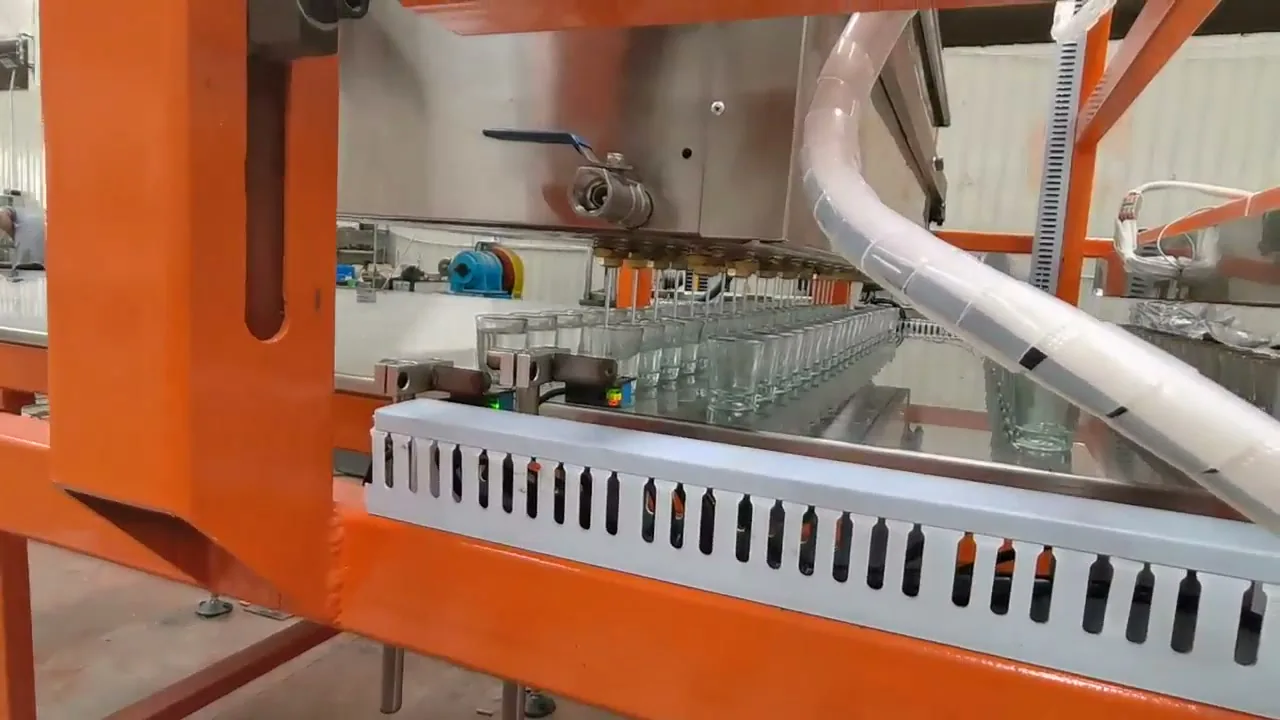
Side-by-Side Comparison for Qualified Setups
| Selection Factor | XY-Gantry Filler | Row-Fill Machine (13 or 19 Nozzles) | Conveyor-Fed Line (Project-Quoted) |
|---|---|---|---|
| Best production profile | Mixed jar/tin sizes (40–100 mm), frequent SKU or scent changes | Long runs of one container size (aluminum cups to large jars) | High, steady volume of standardized jars |
| Container handling | Jars stay still on a swap tray; operator slides trays in and out | Containers arranged in rows matching nozzle spacing along the table | Mechanical infeed and conveyor transfer between stations |
| Changeover work | Swap tray layout and adjust program/fill weight | Match container spacing to nozzle bar spacing and flush manifold | Re-adjust guides, feeder, sensors, and downstream stations |
| Second-pour workflow | Slide a cooled tray directly back under the XY head | Requires re-aligning rows under the nozzle bar or manual top-off | Requires a second dedicated fill head or return loop |
| Fill accuracy | Rated at ±1% (test method confirmed in quotation) | Confirmed per container in quotation | Confirmed per project and sample run |
| Typical operator role | Load/unload trays and monitor fills | Load rows, trigger fill, unload cooled jars | Monitor stations and replenish consumables |
Decision Rules When Both Semi-Automatic Options Fit
- Pick the XY-gantry filler if you run seasonal collections, private-label orders, or multiple jar diameters each week, or if your wax blend regularly needs a second pour. Keeping jars stationary on trays also lowers the risk of disturbing wicks during the pour.
- Pick the row-fill machine if you have three-phase 380 V power, enough floor length for the cooling table, and long runs of one container size whose spacing matches a 13- or 19-hole bar.
- Evaluate a conveyor-fed line only when your current staffing count shows that automating jar loading, wicking, and cooling transfer removes at least one full operator position—and your jar catalog is stable enough that changeover downtime will not wipe out the speed gain.
How to Estimate Accepted Candles per Shift
A common procurement mistake is multiplying a machine’s rated jars-per-minute figure by 480 minutes to project daily output. On the XY-gantry model, for example, the rated speed is 40–60 jars/min depending on fill volume. That number reflects machine dosing speed under specific fill conditions—not accepted, cooled, saleable candles at the end of an 8-hour shift.
Keep Three Output Numbers Separate
- Rated machine fill rate (
jars/min): Dosing speed while the machine is actively filling, dependent on fill volume and viscosity. - Observed net running rate (
jars/min): Real pace during continuous tray or row operation including normal head travel and tray indexing. - Accepted candles per shift (
accepted jars/shift): Finished jars that pass weight, wick, and cooled-surface checks after deducting breaks, SKU/scent changeovers, line purging, cooling bottlenecks, and rejects.
Worked Example Using Assumed Inputs
All figures below are illustrative assumptions to show the calculation method, not a quoted output guarantee for any specific model:
- Scheduled shift: 480 minutes (8 hours)
- Deducted non-running time: 30 minutes scheduled breaks + 30 minutes tray/SKU changeovers + 15 minutes fragrance/color purge + 15 minutes waiting for open cooling racks = 90 minutes
- Net running time:
480 - 90 = 390 minutes - Assumed observed running rate (medium jar fill):
15 jars/min - Assumed post-cool inspection pass rate:
96%(4% held for top-off or rework)
Estimated accepted output: 390 min × 15 jars/min × 0.96 = 5,616 accepted jars/shift
What reverses this calculation: If your wax blend requires a second pour on the same machine, or if you switch scents four times per shift instead of once, net running time drops sharply. Likewise, if your upstream melter cannot supply enough molten wax in kg per hour—or if your cooling racks fill up after 90 minutes—the filler will sit idle regardless of nozzle count. Always check melting capacity, wick preparation, and cooling space alongside the filler.
What a Candle Filling Machine Controls—and What It Does Not
A filling machine improves dosing repeatability and reduces hand-pouring labor, but it cannot fix formulation or cooling problems on its own. Knowing the boundary prevents unrealistic acceptance disputes.
Sinkholes, Frosting, and Air Bubbles
The filler controls how much wax enters each jar and where the nozzle sits. Sinkholes, frosting, and trapped air bubbles come primarily from your wax blend, pour temperature, jar temperature, and room cooling rate. If your blend shrinks during cooling, plan either for container preheating and draft-free cooling or for a second-pour pass—which is straightforward on an XY-gantry swap tray.
Wick Drift and Centering
A strong wax stream or a jolted tray can push an unsecured wick off-center. On an XY-gantry filler, the jars remain stationary while the heads move, which helps reduce sloshing. Still, wick stability depends on two upstream and downstream steps: securing the metal tab cleanly to the jar base (see wick inserting machines) and holding the top of the wick straight until the wax firms up (see wick centering machines). Both are quoted per jar and wick rather than as one-size-fits-all units.
Scent and Color Carryover
Residual wax in hoses, manifolds, and nozzles carries fragrance and dye into the next batch. If you run frequent scent changes, factor line-flushing time and purge wax into your shift plan, and ask how easily the nozzles and heated path drain and clean between batches.
Sample-Run Acceptance Checklist and RFQ Package
Most of our core machines are made in our own factory, and the cleanest way to avoid compatibility surprises is to agree on the sample-run test method, pass criteria, and handover documents in writing before confirming an order.
Sample-Run Acceptance Table
Use this structure to define and record a pre-shipment or sample test with your own materials:
| Check Item | Target / Tolerance | Verification Method | Evidence to Record | Disposition |
|---|---|---|---|---|
| Fill weight repeatability | Agreed target weight (g) and tolerance (e.g., ±1% on XY model; test method confirmed in quotation) | Weigh empty jars, fill batch with production wax, re-weigh filled jars | Batch weight log (empty, gross, net) per SKU | Pending / Pass / Retest |
| Smallest & largest jar fit | Clean nozzle entry without touching wick, holder, or rim | Run both smallest and largest sample jars with production wicks | Close-up photos and video of nozzle positioning | Pending / Pass / Retest |
| Rim drips & spill control | No wax drips on jar rim or exterior requiring manual scraping | Inspect full tray or row immediately after cycle completes | Tray inspection count and photos | Pending / Pass / Retest |
| Wick position & cooled surface | Wick within agreed center offset; confirm whether single or second pour meets surface spec | Inspect after full cooling at room conditions | Post-cool batch count and sample photos | Pending / Pass / Retest |
| Full-cycle timing | Recorded time for load, fill, tray/row swap, and unload | Time consecutive cycles with defined operator count and fill weight | Cycle time sheet noting operator count | Pending / Pass / Retest |
| Handover documentation | Manual, electrical/air diagram, packing list | Verify document set matches quoted configuration before dispatch | Signed handover checklist | Pending / Pass / Retest |
What to Prepare Before Requesting a Quote
Gathering these six inputs lets a manufacturer recommend the right architecture and quote realistic specs for your jars:
- Wax data sheet or blend details: Wax type (soy, paraffin, palm, coconut, or blend), fragrance load, dye, and target pour temperature.
- Container set: Drawings or dimensions (outer diameter, inner opening, height) for your smallest and largest jars, tins, or cups.
- Wick assembly: Wick type (cotton, paper-core, or wood), length, tab size, and whether wicks are set before or after filling.
- Target fill weight and daily volume: Net wax weight per jar (g or oz), acceptable weight tolerance, and target accepted jars per shift.
- SKU mix and changeover schedule: How many jar sizes and scents you run per week, and whether a second pour is needed.
- Site conditions: Local voltage and frequency, compressed air availability, available floor space for trays or a long table, and whether you already have a wax melter.
Frequently Asked Questions
Can one candle filling machine handle soy, paraffin, and blended waxes?
Often yes, provided the required pour temperature stays within the machine’s heating range—up to 100 °C on the standard XY-gantry model—and the wax flows cleanly at that temperature. Send your wax data sheet, fragrance load, and pour temperature so heating, hose routing, and nozzle sizing are confirmed in the quotation.
Does a candle filling machine include a wax melter?
Not automatically. AromaEquip’s XY-gantry filler is a filling station only and pairs with a separate wax melter or heated tank. The row-fill model includes a heated holding pot to feed the nozzle bar, but bulk wax melting is still a separate upstream step.
Is a semi-automatic filler enough for 1,000 to 3,000 jars per day?
In most workshops, yes. At that volume, jar loading, wicking, cooling space, and boxing usually limit output more than the dosing speed of the filler itself. Map your full shift cycle—including cooling racks and scent changeovers—before paying for a conveyor-fed line.
Can the same machine fill lip balm, solid perfume, or other wax-based pastes?
Possibly. The XY-gantry model is rated for molten candle wax, wax oil, and other free-flowing liquids and pastes, including solid fragrance. Share the product’s melting point, viscosity at fill temperature, and container dimensions so compatibility is confirmed before quoting.
What if my jars are wider than 100 mm or taller than 100 mm?
Standard XY-gantry figures cover 40–100 mm diameter and 20–100 mm height, while row-fill machines handle containers from aluminum cups up to large jars depending on nozzle spacing. Send drawings or photos of your oversized jars so any required tray, stroke, or nozzle-bar adjustment is stated in the quotation.
How should I send jar drawings, photos, and wax data sheets for a quote?
Start by sharing your jar sizes, wax blend, target fill weight, and shift goal through the AromaEquip enquiry form. Because the website form collects text details rather than file uploads, send your jar drawings, setup photos, or wax data sheets through the email or WhatsApp contact listed on that page.
Next Step
Compare our candle filling machines and automatic candle filling machines against your four hard-gate checks, or browse the full candle making equipment range if melting or wicking is your current bottleneck. When you are ready to verify fit and output on your own containers, submit your jar dimensions, wax blend, and shift target via the AromaEquip enquiry form to discuss a sample run and quotation.