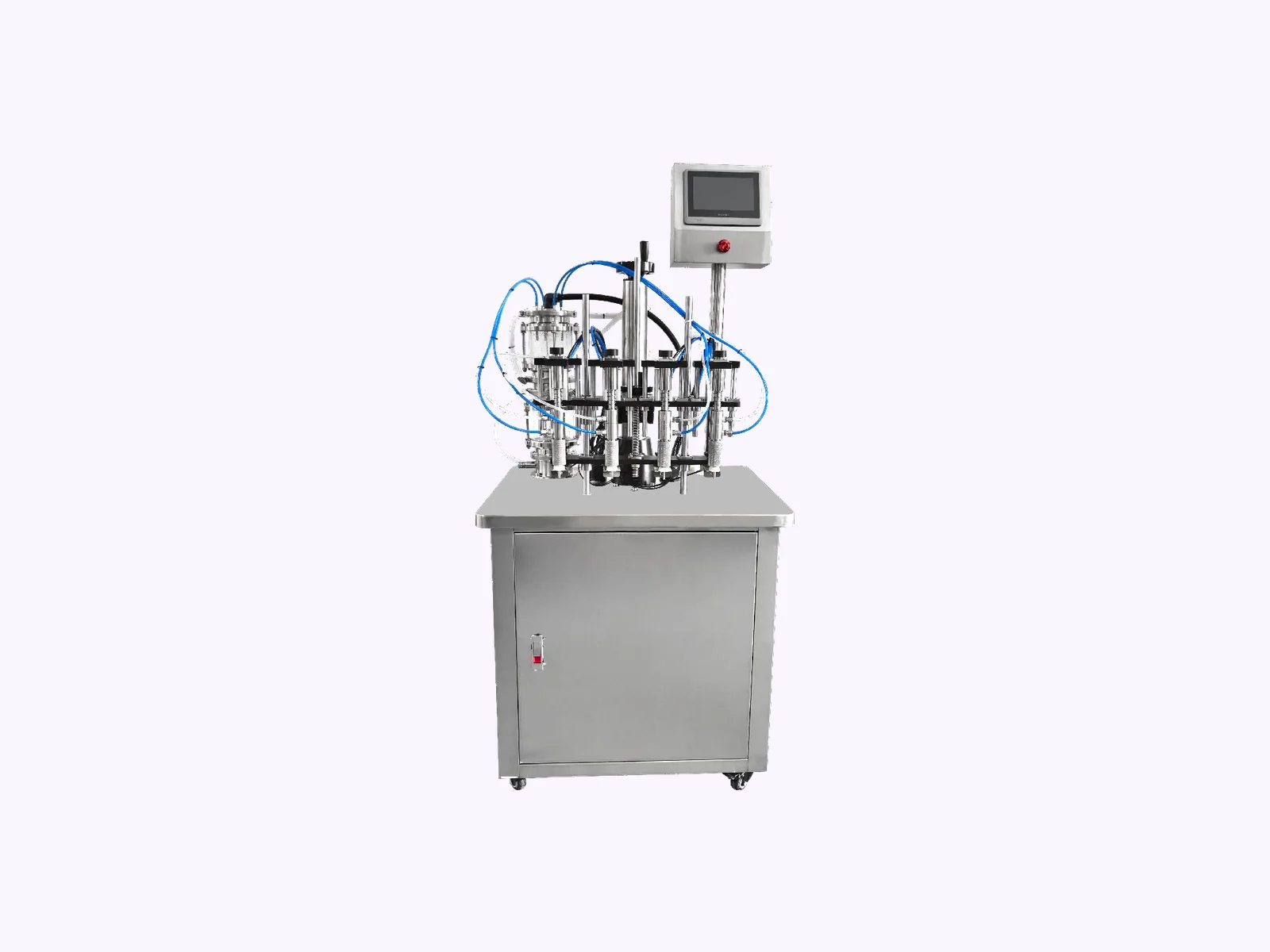
Buying a semi-automatic perfume filling machine comes down to four checks before rated speed: whether your liquid suits constant-level vacuum filling, whether your bottle neck and height fit the filling head, how your workshop handles flammable alcohol vapors and utilities, and how often you switch bottle shapes or fragrances. For narrow-neck bottles (6–25 mm), small batches, or a workbench with compressed air only, a single-head pneumatic filler (10–300 mL, 10–25 bottles/min) is the most compact entry point. For steady production across round, square, or custom bottles up to 500 mL, a four-head vacuum filler (40–60 bottles/min) cuts fill time while keeping quick, mold-free changeovers. Remember that both machines fill only—crimping or capping is a separate step unless you move up to a rotary or linear system.
Start With Four Hard-Gate Checks Before Comparing Fillers
Comparing bottles per minute before checking bottle geometry, liquid behavior, and alcohol safety leads to rework and safety delays. Clear these four gates first.
1. Vacuum Level Filling vs. Volumetric Dosing (and Liquid Viscosity)
Glass perfume bottles—especially heavy-bottom retail flacons—vary slightly in internal volume. AromaEquip’s semi-automatic perfume filling machines use constant-level vacuum (negative-pressure) filling: the machine draws liquid into each bottle until it reaches a set height and returns excess liquid to the tank. Every bottle on the shelf shows the same fill line even when glass wall thickness varies.
Vacuum level filling works best for thin, free-flowing liquids such as perfume, toner, essence, and florida water. It is not designed for thick oils, creams, gels, or pastes, nor for tiny 1–20 g precision doses where exact weight matters more than visual meniscus height—for those applications, look at essential oil filling machines instead. If your label compliance requires strict net-volume limits alongside visual consistency, test both liquid height and net weight on your own bottles before ordering.
2. Bottle Neck Inside Diameter, Body Diameter, and Height
The filling head must enter and seal cleanly at the bottle mouth without chipping glass or catching on narrow rims. Measure your smallest and largest bottles before choosing a machine:
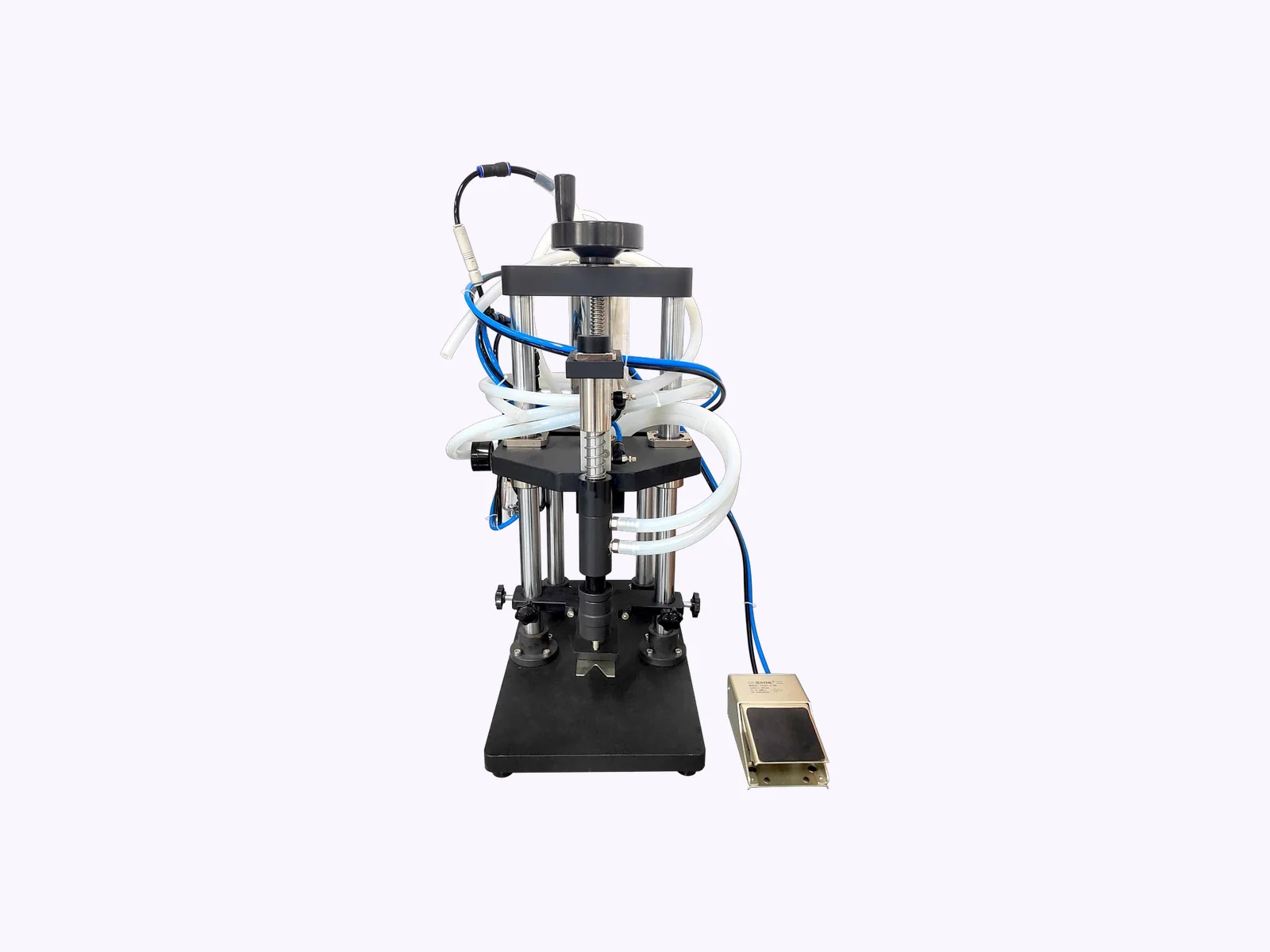
- Single-head pneumatic filler: Fits 6–25 mm diameter/neck bottles, 50–200 mm high (customizable), for 10–300 mL fills.
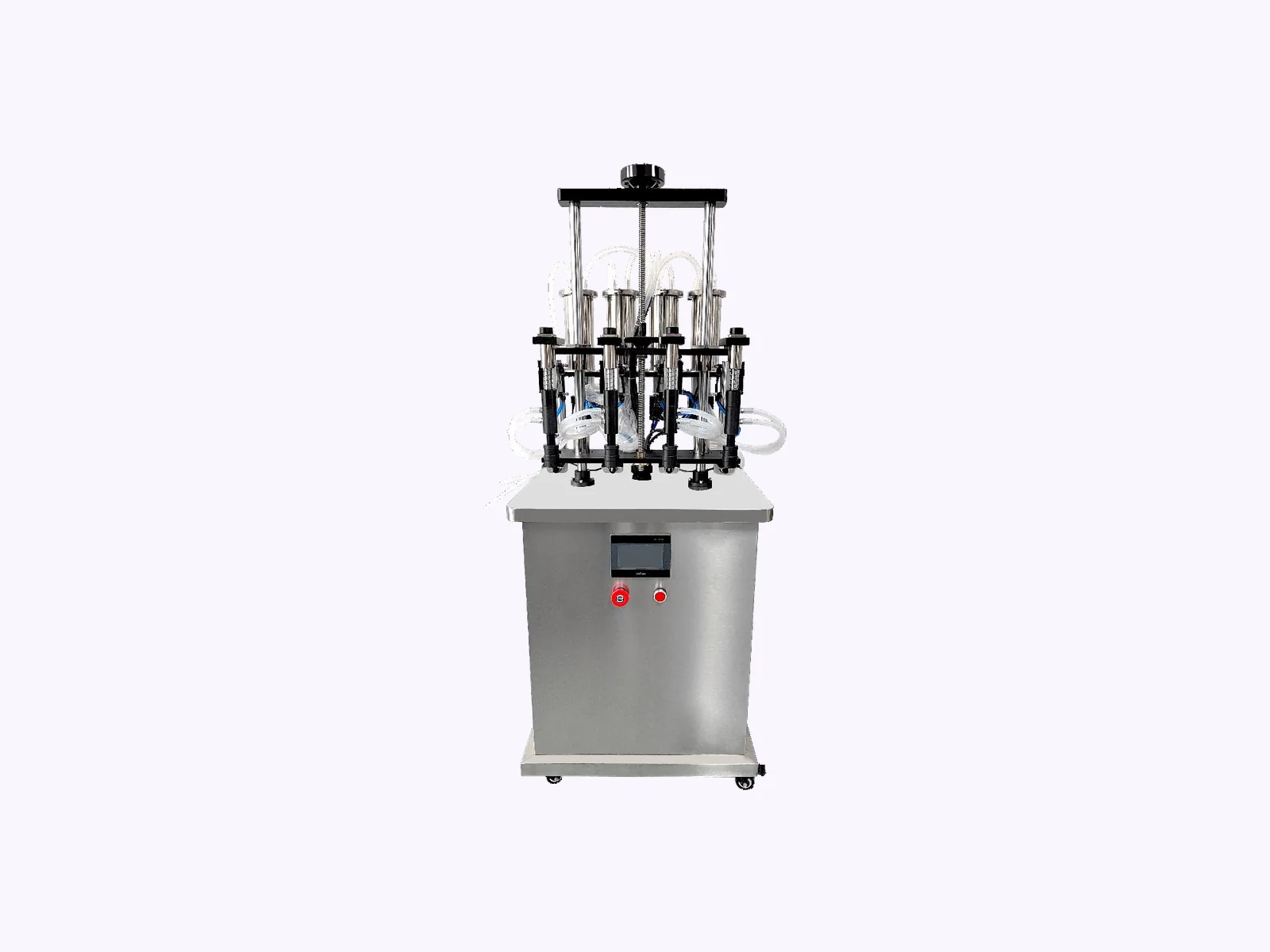
- Four-head vacuum filler (standard and upgraded): Fits 7–100 mm bottle diameter, 50–300 mm high, for 10–500 mL fills across round, square, and special-shaped bottles.
Very narrow vials or tall decorative bottles outside these limits require a sample check so nozzle tip diameter and column stroke are confirmed in the quotation.
3. Alcohol Vapor Safety and Site Utilities
Most commercial perfumes contain high-proof ethanol, which releases flammable vapor at the filling station. Do not treat a standard electrical liquid filler as automatically suitable for hazardous areas—and never rely on a general company certificate as proof that a specific machine is explosion-proof.
Before quoting, confirm three site items:
- Electrical and ventilation review: Share your liquid’s alcohol percentage and local fire-code requirements so electrical configuration and local vapor extraction at the filling point are reviewed upfront.
- Air-only vs. 220 V supply: The single-head pneumatic filler runs entirely on 0.4–0.6 MPa compressed air with no electricity, keeping electric motors out of the vapor zone (your site still needs vapor extraction and a safety review). The four-head vacuum fillers require 220 V / 50 Hz (0.2 kW).
- Spill containment: Plan a drip tray under the filling heads and an alcohol-safe wiping and flushing routine.
4. Bottle Stability Under Hand Loading
On a semi-automatic filler, an operator places and removes every bottle by hand. Lightweight plastic vials, narrow-base tubes, or irregular glass flacons can tilt under suction or head movement and spill on the collar. Confirm what base guide or positioning block holds each bottle shape upright during the fill cycle.
Single-Head Pneumatic vs. Four-Head Vacuum: Choosing Between Qualified Models
Once your liquid, bottles, and site utilities pass the hard gates, AromaEquip’s semi-automatic range gives you three distinct configurations: the air-only single-head filler, the standard four-head vacuum filler, and the upgraded four-head vacuum filler.
Side-by-Side Specifications
| Parameter | Single-Head Pneumatic Filler | 4-Head Vacuum Filler (Standard) | 4-Head Vacuum Filler (Upgraded) |
|---|---|---|---|
| Filling principle | Constant-level, height-adjustable column | Constant-level vacuum (4 heads) | Constant-level vacuum (4 stainless heads) |
| Fill volume range | 10–300 mL | 10–500 mL | 10–500 mL |
| Bottle diameter / neck | 6–25 mm | 7–100 mm | 7–100 mm |
| Bottle height | 50–200 mm (customizable) | 50–300 mm | 50–300 mm |
| Bottle shapes | Narrow-neck & small bottles | Round, square, and special-shaped | Round, square, and special-shaped |
| Rated machine speed | 10–25 bottles/min | 40–60 bottles/min | 40–60 bottles/min |
| Power / air supply | 0.4–0.6 MPa compressed air only (no electricity) | 220 V / 50 Hz, 0.2 kW | 220 V / 50 Hz, 0.2 kW |
| Machine dimensions | 230 × 390 × 620 mm (benchtop) | 750 × 600 × 1,600 mm | 710 × 500 × 1,540 mm |
| Key hardware notes | Compact foot-pedal operation | Front control panel on stainless cabinet | Stainless heads, upgraded return tank, large top touch screen |
| Bottle closing | Separate machine | Separate machine | Separate machine |
Decision Rules When Multiple Models Fit
- Choose the single-head pneumatic filler if you bottle small trial runs, sample sizes, or narrow-neck flacons (6–25 mm), have only benchtop space (230 × 390 mm), or specifically want an electricity-free air-driven station in your filling area.
- Choose the standard four-head vacuum filler if you run mixed retail bottle sizes up to 500 mL and 300 mm tall, want to fill four bottles per cycle with quick manual guide changes, and need a straightforward floor-standing cabinet.
- Choose the upgraded four-head vacuum filler if you run frequent daily batches and scent flushes where stainless-steel filling heads, an upgraded return tank for overflow recovery, a larger top-mounted touch screen, and a slightly slimmer footprint (710 × 500 × 1,540 mm) simplify operation and cleaning.
When to Step Up From Semi-Automatic to Rotary or Linear
Semi-automatic fillers keep upfront cost low and make switching between round, square, and custom bottles fast because there are no conveyors or custom star-wheel molds to change. However, they fill only.
Evaluate automatic perfume filling machines instead when hand-crimping and bottle transfer become your main labor bottleneck on steady bottle shapes:
- Rotary four-head perfume filler: Still hand-loaded onto a turntable, but combines 4-head filling (10–500 mL, ≤ ±1% fill error), automatic crimping (13, 15, 17, 19, or 22 mm), and automatic collar pressing or screw capping at 1,000–1,200 bottles/h (10–70 mm bottle diameter, 60–200 mm height, 220 V / 50 Hz, approx. 600 kg, 1,200 × 1,000 × 1,700 mm). Odd bottle shapes require custom molds.
- Linear perfume filling and crimping line: Feeds bottles by conveyor through vacuum filling, dual-lane automatic crimping (15–22 mm, customizable), and automatic pressing at 30–50 bottles/min on 100 mL bottles (220 V, 0.5–0.7 MPa compressed air). Best reserved for high, steady volume with dedicated floor length.
How to Estimate Accepted Bottles per Shift
On a hand-loaded semi-automatic filler, the operator—not the machine’s rated fill rate—usually sets the real pace. A four-head vacuum filler is rated at 40–60 bottles/min, and a single-head pneumatic filler at 10–25 bottles/min, but neither number accounts for hand loading, scent flushing, bottle-guide adjustments, or waiting on a separate crimping station.
Worked Example Using Assumed Inputs
All figures below are illustrative assumptions to show how to size a shift, not a guaranteed output for any model:
- Scheduled shift: 480 minutes (8 hours)
- Deducted non-running time: 30 minutes scheduled breaks + 25 minutes bottle-height/guide changeovers + 25 minutes fragrance-change line flushing + 20 minutes waiting on downstream crimping and tray handling = 100 minutes
- Net running time: 480 - 100 = 380 minutes
- Assumed operator-paced running rate (one operator loading a 4-head filler): 16 bottles/min
- Assumed inspected pass rate (fill level, clean neck, tight crimp): 97%
Estimated accepted output: 380 min × 16 bottles/min × 0.97 = 5,897 accepted bottles/shift (rounded down to whole bottles)
What reverses this estimate: Adding a second operator to stage and remove bottles can raise the net running rate toward the machine’s limit, while running five short fragrance batches in one shift—requiring four full alcohol flushes—cuts net running minutes sharply. Always time your downstream crimper or capper alongside the filler so finished open bottles do not pile up and evaporate while waiting to be closed.
Pairing Your Filler With Closing Equipment and Running a Sample Test
Because semi-automatic fillers only dispense liquid, plan the closing station and the pre-shipment acceptance test together before ordering.
Matching the Closing Machine to Your Closure Type
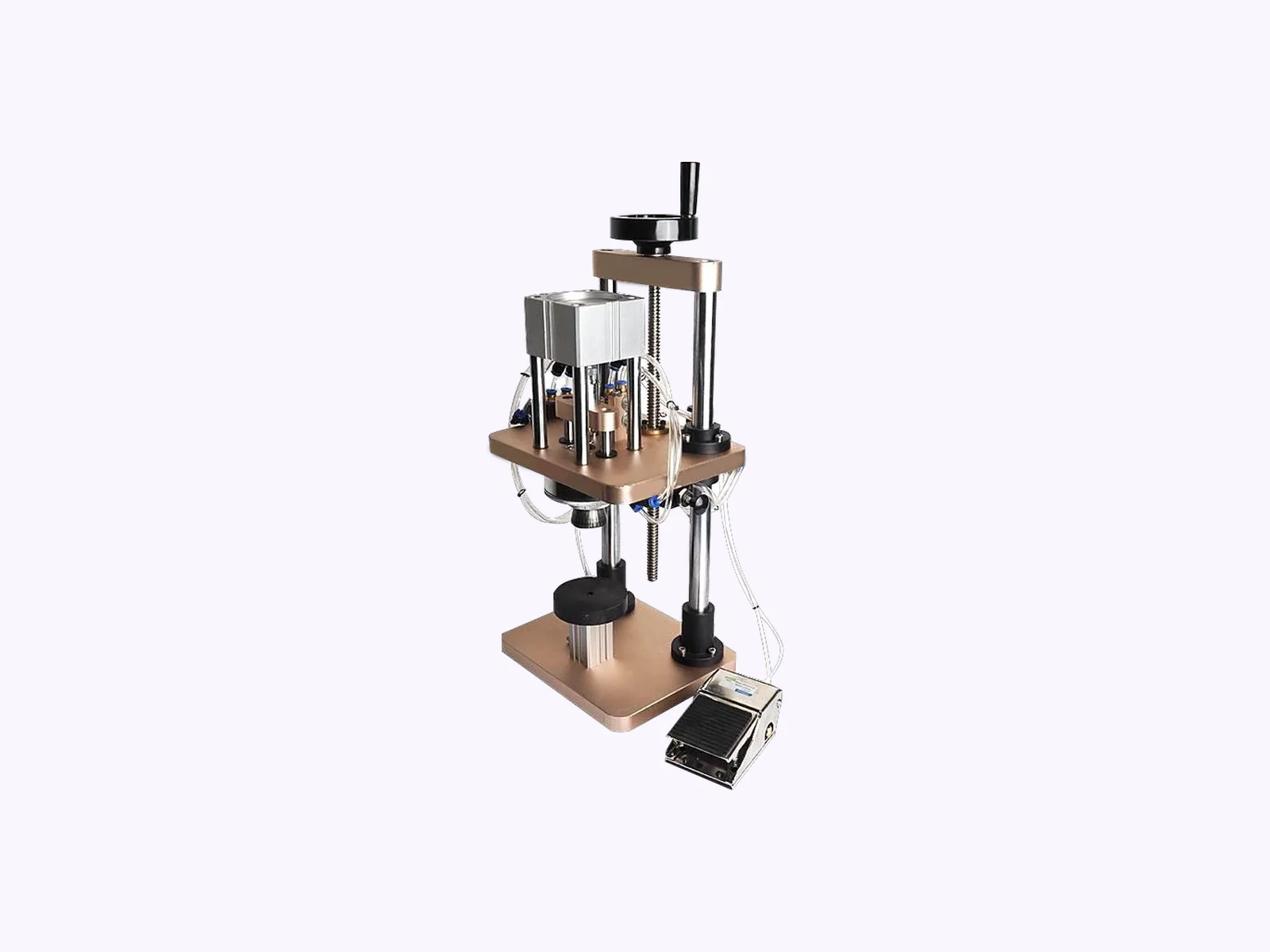
- Crimp-neck spray pumps: Pair with a pneumatic unit from our perfume crimping machines range. The benchtop pneumatic crimper runs on 0.4–0.6 MPa compressed air with no electricity, covers 13, 15, 17, 20, or 22 mm crimp collars on bottles 30–300 mm tall and 15–100 mm wide at 15–40 bottles/min, and measures 280 × 280 × 530 mm. Always match the exact crimp collet to your pump and bottle neck.
- Press-on decorative collars or snap pumps: Pair with a pneumatic cap press (10–50 mm customizable collar range, 15–300 mm bottle height, 20–40 bottles/min, 0.4–0.6 MPa, 250 × 230 × 550 mm; see perfume pump pressing machines).
- Threaded caps or screw-on sprayers: Pair with a benchtop semi-automatic bottle capping machine (15–350 mm bottle height, 25–50 bottles/min, 220 V / 50 Hz, 120 W, 0.4–0.6 MPa, 500 × 380 × 700 mm).
Sample-Run Acceptance Table
Most of our core machines are made in our own factory. Write the test liquid, pass criteria, and handover documents into your quotation before confirming an order so both sides judge performance the same way:
| Check Item | Target / Tolerance | Verification Method | Evidence to Record | Disposition |
|---|---|---|---|---|
| Fill-level consistency | Uniform visual liquid line across batch (and net weight within agreed tolerance if required) | Fill 50 production bottles at normal working speed and line them up side by side | Batch level photo + optional weight log | Pending / Pass / Retest |
| Two-operator repeatability | Consistent fill level and cycle pace across different operators | Have two operators run consecutive trays on the same setup | Cycle time and reject count per operator | Pending / Pass / Retest |
| Neck fit & drip control | Clean nozzle entry; zero drips on neck, collar, or exterior glass | Inspect smallest and largest bottle necks immediately after head lift | Close-up neck inspection count and photos | Pending / Pass / Retest |
| Bottle stability & foam | Zero tipping; foam settles without false shutoff or overflow | Run at target speed with production liquid or matched-viscosity test liquid | 15-minute run video and stop log | Pending / Pass / Retest |
| Fragrance flush & changeover | Agreed flush minutes and zero carryover between two scents | Time full purge and bottle-height/guide reset between two SKUs | Changeover and purge time sheet | Pending / Pass / Retest |
| Handover documentation | Manual, air/electrical diagram, spare-parts list matching quoted config | Verify documents against machine nameplate before dispatch | Signed handover checklist | Pending / Pass / Retest |
Six Inputs to Prepare for Your RFQ
- Bottle set: Drawings or dimensions (inside neck diameter, outer diameter, height, base shape) for every bottle you plan to run.
- Liquid profile: Fragrance type, alcohol/solvent percentage, viscosity (water-thin vs. oil-heavy), and whether it foams.
- Fill target: Volume per bottle (mL) and whether your quality check is visual fill line, net weight, or both.
- Closure details: Crimp collar size (mm), press-on collar, or threaded cap—plus whether you need a paired crimper or capper.
- Batch and shift plan: Bottles per batch, target accepted bottles per shift, and how many scent or bottle changes happen each week.
- Site utilities: Local voltage and frequency, compressed air pressure (0.4–0.6 MPa), bench or floor space, and vapor extraction setup.
Frequently Asked Questions
Is the single-head perfume filling machine really electricity-free?
Yes. The single-head pneumatic model runs solely on 0.4–0.6 MPa compressed air with a foot pedal and no electrical connection, which keeps electric motors out of the alcohol vapor zone. Your workshop still needs proper vapor extraction and a site safety review for flammable liquids.
What is the difference between the standard and upgraded four-head vacuum fillers?
Both share the same 10–500 mL fill range, 7–100 mm bottle diameter, 50–300 mm height, 40–60 bottles/min rated speed, and 220 V / 50 Hz (0.2 kW) power rating. The upgraded model adds stainless-steel filling heads, an upgraded return tank, and a larger top-mounted touch screen in a slightly more compact 710 × 500 × 1,540 mm cabinet (versus 750 × 600 × 1,600 mm on the standard model).
Can one semi-automatic filler handle both 15 mL travel sprays and 100 mL perfume bottles?
Often yes, as long as both bottles stay within the machine’s diameter, neck, and height range (6–25 mm and 50–200 mm on the single-head; 7–100 mm and 50–300 mm on the four-head vacuum). You adjust the filling column height and swap or reposition the bottle base guide between sizes—send both bottles so nozzle clearance is confirmed before quoting.
Why does a vacuum filler leave uneven volumes if I weigh the bottles?
Vacuum filling stops at a fixed liquid height so every glass bottle looks identical on the shelf. Because glass bottles vary slightly in internal cavity volume, matching the fill line means slight weight differences from bottle to bottle. If your market requires strict net-weight filling instead, tell us your tolerance during quoting.
Can I fill essential oils or thick fragrance oils on a vacuum perfume filler?
Thin, free-flowing fragrance liquids work well on vacuum level fillers, but thicker oils, balms, or tiny 1–20 g essential oil doses do not. For small precision doses or thicker liquids, compare our essential oil filling machines and share your liquid viscosity.
How do I send bottle drawings, photos, and liquid safety data for a quote?
Start by sending your bottle dimensions, alcohol percentage, fill volume, and hourly target through the AromaEquip enquiry form. Because the web form collects text project details rather than file uploads, share bottle drawings, setup photos, or safety data sheets via the email or WhatsApp contact listed on that page.
Next Step
Compare specifications on our semi-automatic perfume filling machines and perfume filling machines pages, or review the full fragrance and perfume equipment lineup if you also need crimping or capping. When you are ready to confirm nozzle fit, alcohol safety review, and sample testing for your bottles, send your bottle range, liquid details, and batch target via the AromaEquip enquiry form.