Industrial labeling machines are classified along two practical axes: container geometry (round wrap-around, flat surface, or double-sided front-and-back) and feeding level (conveyor-fed automatic vs. hand-placed semi-automatic). Choosing the right type starts with your container shape, not rated labels per minute. Round bottles and jars need a wrap-around labeler; cartons, boxes, and pouches need a flat-surface labeler; flat or square bottles with front and back panels need a double-sided machine to align both labels in one pass. Across AromaEquip’s roll labelers, conveyor-fed automatic models run 30–120 containers/min at ±1 mm placement, while benchtop semi-automatic models run 20–35 containers/min at tighter ±0.5 mm placement for short runs and frequent SKU changes.
The Five Core Types of Industrial Roll Labeling Machines
Every roll labeling machine peels a pressure-sensitive label from its backing web and presses it onto a container, but the mechanical handling changes completely with package shape and line speed.
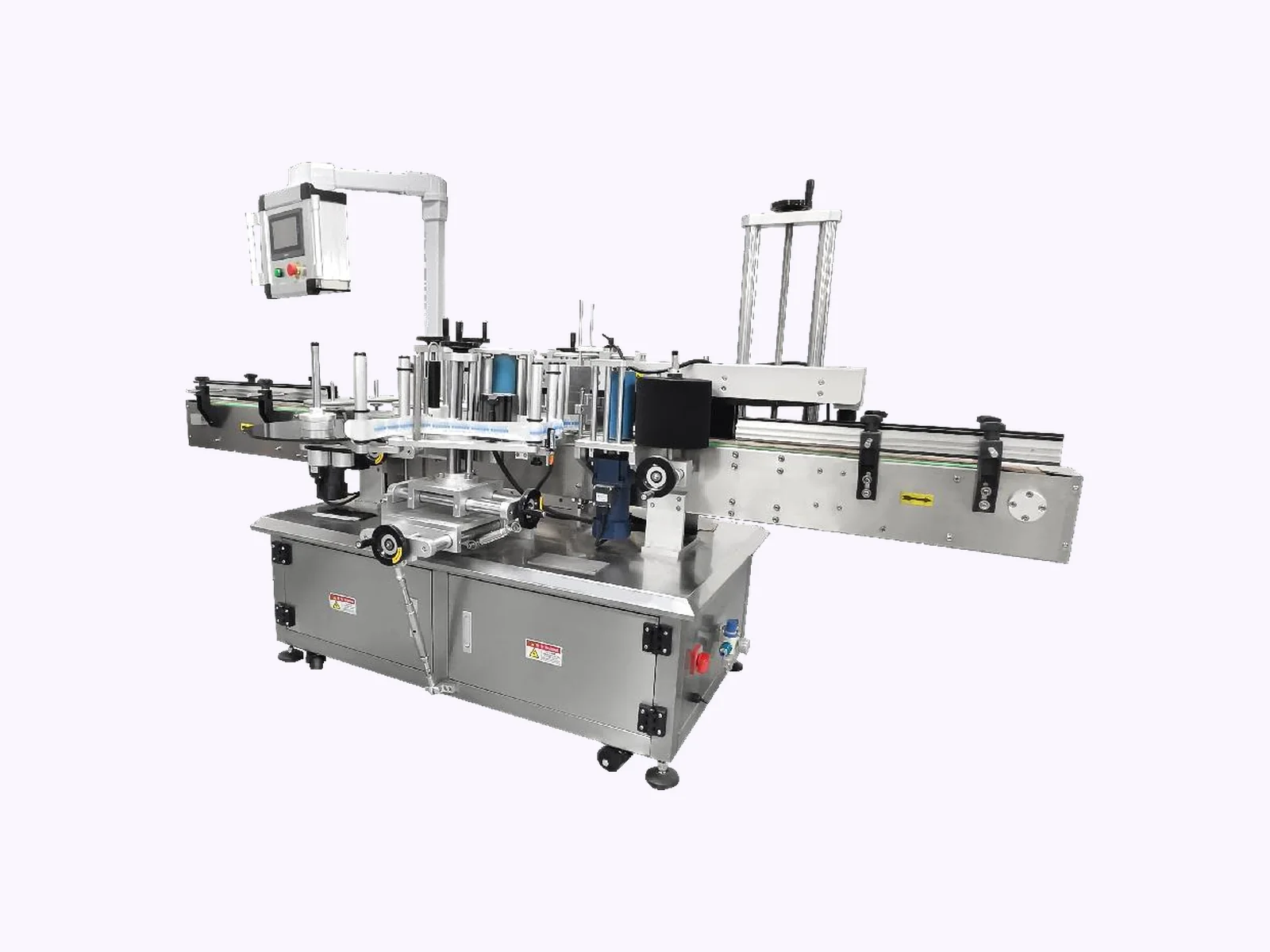
1. Automatic Flat Surface Labeling Machines
An automatic flat surface labeling machine runs cartons, boxes, lids, trays, or flat pouches along a horizontal conveyor beneath a top-mounted dispensing head. Sensors detect each passing item and wipe or tamp the label onto the planar face.
- Best for: Corrugated cartons, folding boxes, cosmetic pouches, and flat lids on a continuous packing line.
- Key specs: Items 40–400 mm long, 40–200 mm wide, and 0.2–150 mm high; label length 6–150 mm, backing width 6–130 mm; 40–120 items/min at ±1 mm placement; 220 V / 50 Hz, 2 kW; 1,900 × 830 × 1,350 mm.
2. Automatic Round Bottle (Wrap-Around) Labeling Machines
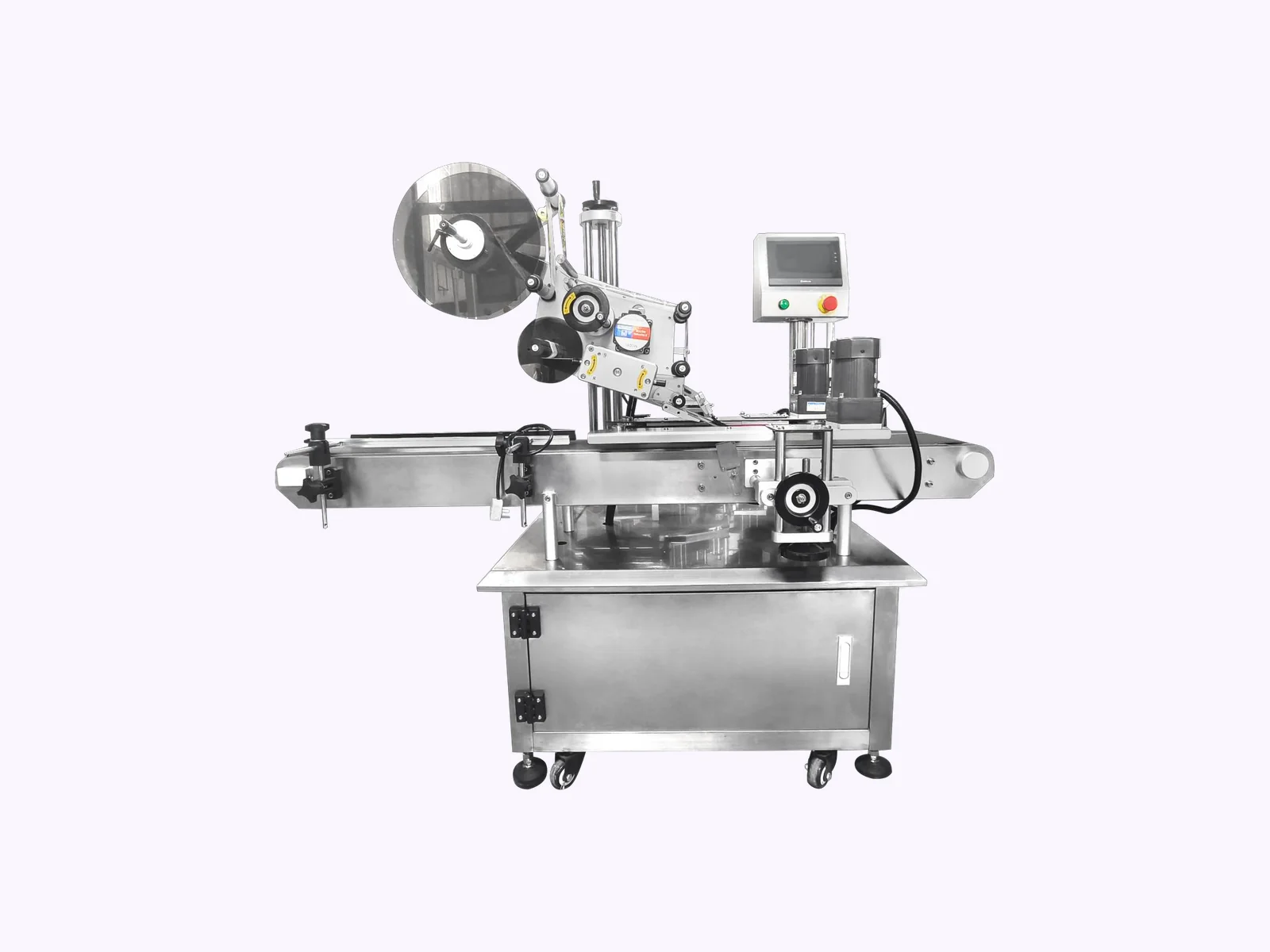
An automatic round bottle labeling machine rolls cylindrical containers between a conveyor belt and a wrap station so the label lays smoothly around the circumference. It can apply a single full/partial wrap or two spaced labels (such as front and back) on the same cylinder.
- Best for: Straight-walled glass or plastic bottles, candle jars, tins, and cans running in steady production.
- Key specs: Round diameters 25–300 mm; label length 20–290 mm (customizable to sample); 40–70 bottles/min; 0.4–0.6 MPa compressed air; 1,950 × 1,200 × 1,530 mm.
3. Automatic Double-Sided (Front-and-Back) Labeling Machines
An automatic double-sided labeling machine stabilizes containers on a conveyor—typically with an overhead hold-down belt—and applies labels to both opposite faces in a single pass. You can also switch off one head for single-side runs.
- Best for: Flat, square, or round bottles (and oval bottles tested to sample) where front and back labels must sit at the exact same height without running containers through a machine twice.
- Key specs: Flat, round, and square bottles 20–120 mm across; label length 20–300 mm, backing width 20–170 mm; max roll outside diameter 300 mm on a 76 mm core; 30–120 items/min at ±1 mm placement; 220 V / 50 Hz; machine footprint quoted per configuration.
4. Semi-Automatic Round Bottle Labeling Machines
A benchtop semi-automatic round labeler (part of our semi-automatic labeling machines range) cradles one cylindrical bottle or vial at a time on twin rollers. The operator places the container and triggers a cycle (or runs a timed auto cycle), giving tighter manual alignment and quick size adjustments without conveyor guides.
- Best for: Small-to-medium batches, narrow vials down to 10 mm diameter, and multi-SKU candle or fragrance brands switching bottle sizes daily.
- Key specs: Round diameters 10–160 mm, height up to 250 mm; single or double labels 20–380 mm long and 20–220 mm wide; 76 mm core; 20–35 items/min at ±0.5 mm placement; approx. 920 × 470 × 500 mm; 45 kg.
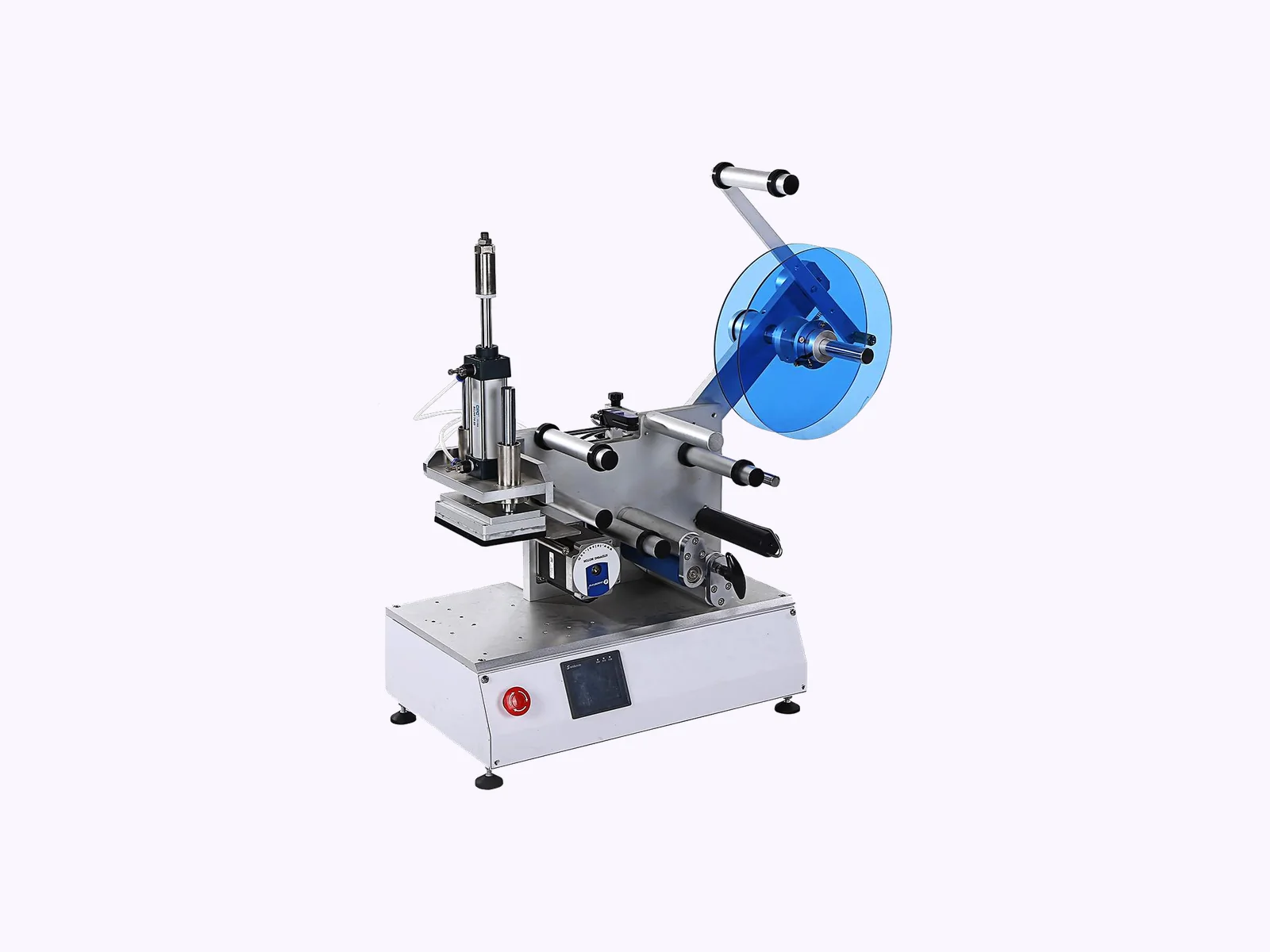
5. Semi-Automatic Flat Surface Labeling Machines
A benchtop semi-automatic flat labeler uses a vertical pneumatic tamp pad to press a label onto a hand-positioned package. Because the operator locates the item in a nest or fixture, it handles more surface variation than a fixed conveyor head.
- Best for: Short runs of boxes, pouches, and irregular, lightly curved, concave, or convex faces where ±0.5 mm placement matters more than conveyor speed.
- Key specs: Items 20–200 mm long, 20–150 mm wide, and 0.2–120 mm thick; labels 15–100 mm long and 15–110 mm wide; 76 mm core; 20–30 items/min at ±0.5 mm placement; 920 × 470 × 500 mm; 41 kg.
Side-by-Side Comparison of the Five Labeling Machine Types
Use this matrix to compare container fit, roll capacity, accuracy, utilities, and floor space before shortlisting models:
| Parameter | Auto Flat Surface | Auto Round (Wrap) | Auto Double-Sided | Semi-Auto Flat (Bench) | Semi-Auto Round (Bench) |
|---|---|---|---|---|---|
| Primary containers | Cartons, boxes, pouches, flat packs | Round bottles, jars, cans | Flat, round, and square bottles | Flat, curved, concave, convex items | Round bottles, jars, vials |
| Container range | L 40–400, W 40–200, H 0.2–150 mm | Dia 25–300 mm | Dia/width 20–120 mm | L 20–200, W 20–150, T 0.2–120 mm | Dia 10–160 mm, H up to 250 mm |
| Label dimensions | L 6–150 mm; backing 6–130 mm | L 20–290 mm (to sample) | L 20–300 mm; backing 20–170 mm | L 15–100 mm; W 15–110 mm | L 20–380 mm; W 20–220 mm |
| Roll core / max OD | Confirm in quotation | Confirm in quotation | 76 mm core / 300 mm OD | 76 mm core | 76 mm core |
| Placement accuracy | ±1 mm | Confirmed to sample | ±1 mm | ±0.5 mm | ±0.5 mm |
| Rated speed | 40–120 items/min | 40–70 bottles/min | 30–120 items/min | 20–30 items/min | 20–35 items/min |
| Power / air | 220 V / 50 Hz, 2 kW | 0.4–0.6 MPa air | 220 V / 50 Hz | Confirmed per order | Confirmed per order |
| Size & weight | 1,900 × 830 × 1,350 mm | 1,950 × 1,200 × 1,530 mm | Quoted per config | 920 × 470 × 500 mm; 41 kg | Approx. 920 × 470 × 500 mm; 45 kg |
How to Match Your Container and Line to the Right Type
Once you narrow down the applicator geometry, run four hard-gate checks before deciding between automatic and semi-automatic.
1. Check Container Taper, Rigidity, and Surface Condition
Straight-walled glass or rigid plastic containers label cleanly. Three physical conditions frequently derail a standard setup and must be tested upfront:
- Tapered walls: A conical bottle or tapered candle jar makes a straight wrap label skew upward or downward. Send the container so guide tilt or a different labeling method can be verified.
- Soft or squeezable walls: Thin plastic bottles flex under wrap pressure and trap air bubbles; test your exact bottle and label stiffness together.
- Wax, oil, dust, or condensation: Residue on candle jars, cardboard dust on cartons, or moisture on chilled bottles weakens adhesive grip. Label after containers are clean, dry, and cooled.
2. Verify Label Roll Specs and Material Sensors
AromaEquip builds labeling machines only and does not supply label rolls, so your roll converter’s specs must match the machine head. Confirm four details before ordering:
- Label length and backing width: Must sit inside the model’s peel-plate limits (for example, 6–130 mm backing width on the automatic flat model, or 20–170 mm on the automatic double-sided model).
- Roll core and outer diameter: Bench and double-sided models use a standard 76 mm inside core, and the double-sided labeler accepts rolls up to 300 mm outside diameter—larger rolls reduce mid-shift stops.
- Label stock opacity: Paper, opaque film, and clear (no-label-look) film require different label-gap sensors; specify transparent labels before quoting.
3. Decide Between Semi-Automatic (±0.5 mm) and Automatic (±1 mm)
Counterintuitively, benchtop semi-automatic labelers list tighter placement accuracy (±0.5 mm) than conveyor-fed automatic models (±1 mm), because each container rests against a fixed stop rather than moving at belt speed.
- Choose a semi-automatic bench labeler if you run short batches, switch bottle or box sizes several times a day, label narrow vials down to 10 mm diameter, have limited bench space (920 × 470 mm), or require ±0.5 mm placement on high-end packaging.
- Choose an automatic conveyor labeler (see automatic labeling machines) when hand-labeling bottlenecks your filler or capper, your container runs are steady enough to justify guide setup time, and you want sensor-triggered 30–120/min output on a shared conveyor height.
Wrap-Length Math and Estimating Accepted Output per Shift
Two quick calculations prevent the most common labeling mistakes: ordering labels that leave an unintended seam gap, and overestimating shift output from nameplate speed.
Wrap-Around Label Length Check
For cylindrical bottles and jars, measure the diameter strictly at the label panel—not at the widest shoulder or cap—and multiply by π (3.1416):
Example (60 mm straight bottle): Circumference = 3.1416 × 60 mm ≈ 188.5 mm
- For a full wrap with overlap, add your desired overlap (e.g., 5–10 mm) so the ends meet cleanly.
- For a partial wrap with a visible gap, subtract the desired gap from 188.5 mm and verify that the resulting label length fits inside the machine’s label-length range (20–290 mm on the automatic round model; 20–380 mm on the bench round model).
Worked Shift-Output Example Using Assumed Inputs
All figures below are illustrative assumptions to show how to size a shift, not a guaranteed output for any specific machine:
- Scheduled shift: 480 minutes (8 hours)
- Deducted non-running time: 30 minutes scheduled breaks + 20 minutes label-roll changes and splice checks + 25 minutes container-guide changeovers + 15 minutes waiting on upstream capping = 90 minutes
- Net running time: 480 - 90 = 390 minutes
- Assumed steady conveyor pace (matched to upstream capper on an automatic round labeler): 45 bottles/min
- Assumed inspection pass rate (placement offset, zero bubbles, clean seam): 98%
Estimated accepted output: 390 min × 45 bottles/min × 0.98 = 17,199 accepted labeled bottles/shift
What reverses this calculation: Running small label rolls that force a stop every 20 minutes, switching between four bottle diameters per shift, or pairing a 70/min labeler behind a 25/min capper all cap real output. On a double-sided labeler, remember that two label rolls run simultaneously—stagger or plan both roll changes together.
When a Roll Labeler Is Not Enough—and How to Run a Sample Test
Roll labelers excel on smooth, consistent containers at production volume, but some packaging jobs belong on a different branding process.
Roll Labeler vs. UV DTF Crystal Label Printing
If you need short runs across many SKUs, raised glossy branding on screw lids or metal tins, or metallic gold and silver foil effects without ordering custom die-cut foil rolls, consider a UV DTF printer instead. UV DTF printers print color, white, varnish, and adhesive layers onto film at 2400 DPI in A2 (420 mm) or 60 cm (600 mm) widths (5.6–6.8 m²/h at 8 pass), with dual-film four-head models adding gold or silver foil stamping. Note the boundary: UV DTF produces transfer stickers applied by hand—it is not a conveyor-fed roll applicator, nor is it a traditional standalone hot-stamping press.
Sample-Run Acceptance Table
Most of our core machines are made in our own factory. Before confirming an order, write the test containers, placement tolerance, and 24-hour adhesion check into your quotation:
| Check Item | Target / Tolerance | Verification Method | Evidence to Record | Disposition |
|---|---|---|---|---|
| Placement accuracy | Within ±1 mm (automatic) or ±0.5 mm (semi-automatic) of target drawing | Label 50 production containers and measure height/horizontal offset | 50-piece measurement log + photos | Pending / Pass / Retest |
| Surface finish | Zero wrinkles, creases, or trapped air bubbles | Visually inspect full test batch under angled light | Defect count and close-up photos | Pending / Pass / Retest |
| Seam or front-to-back alignment | Consistent wrap overlap/gap, or front and back labels level at same height | Measure seam gap (round) or relative front/back height (double-sided) | Alignment check sheet | Pending / Pass / Retest |
| 24-hour adhesion & edge hold | Zero edge lift after 24 hours (and after warm-jar test for candle jars) | Re-inspect labeled containers 24 hours after application | Post-24h inspection photo log | Pending / Pass / Retest |
| Continuous run & changeover | Agreed stop limit over 15–30 min run; timed guide/roll switch | Run continuous batch at target speed, then time one SKU change | Run log and changeover time sheet | Pending / Pass / Retest |
| Handover documentation | Manual, wiring/air diagram, spare-parts list matching quoted config | Verify document set against machine before shipment | Signed handover checklist | Pending / Pass / Retest |
Six Inputs to Prepare for Your RFQ
- Container set: Samples or dimensional drawings (diameter, length, width, height, taper, material) for every package you plan to label.
- Label roll details: Label length, height, backing width, roll core (76 mm), outer diameter, and stock type (paper, opaque film, or clear film).
- Label placement drawing: Exact position on the container (wrap seam overlap, top/bottom face, or front-and-back heights).
- Target speed and shift plan: Containers per minute (or per shift), number of SKUs per week, and upstream filler/capper speed.
- Surface conditions: Note any wax residue, oil, condensation, or warm-container exposure (especially for candle jar labeling machines).
- Site utilities and layout: Local voltage and frequency, compressed air availability (0.4–0.6 MPa for automatic round), floor or bench space, and conveyor height.
Frequently Asked Questions
Can one labeling machine handle both round bottles and flat boxes?
Usually no. Round containers require rolling wrap-around contact, while flat boxes require top or side tamp/wipe application. The exception is our automatic double-sided labeler, which handles flat, round, and square bottles (20–120 mm across) using appropriate guides—though flat pouches and wide cartons still belong on a dedicated flat-surface labeler.
Why are semi-automatic labeling machines rated at ±0.5 mm while automatic machines are rated at ±1 mm?
On a semi-automatic bench labeler, each container is seated against a physical stop before the head cycles, minimizing motion variation. On a high-speed conveyor automatic labeler running 30–120 containers/min, slight belt and container-guide play widens the practical placement tolerance to ±1 mm.
What is the smallest bottle diameter a labeling machine can handle?
On our semi-automatic round bottle labeler, container diameters go down to 10 mm (up to 160 mm diameter and 250 mm tall), making it suitable for small vials and sample bottles. The conveyor-fed automatic round labeler starts at 25 mm diameter (up to 300 mm).
Can a round bottle labeling machine apply both a front and a back label?
Yes. Both the automatic round bottle labeler and the benchtop semi-automatic round labeler support single or double labels around a cylindrical body. For flat or square bottles that need opposite faces labeled simultaneously, choose an automatic double-sided labeler instead.
Do labeling machines work with transparent (clear) labels?
Yes, but transparent film labels require a compatible label-gap sensor (such as an ultrasonic or capacitive sensor rather than a standard optical sensor). Always specify clear label stock and send a real label roll sample before quoting so the correct sensor is configured.
How should I send container drawings, label roll specs, and line photos for a quote?
Start by sending your container shape, label dimensions, and hourly target through the AromaEquip enquiry form. Because the website form collects text project details rather than file uploads, share container drawings, label layout files, or line photos via the email or WhatsApp contact listed on that page.
Next Step
Explore specs across our labeling machines, bottle labeling machines, and full labeling and branding equipment lineup to narrow down your container class. When you are ready to confirm label-roll fit, sensor setup, and a 50-piece sample test, send your container dimensions, label size, and line speed via the AromaEquip enquiry form.